01 / RESEARCH DIRECTION
Mathematics for AI
How do signals and gradients travel through a neural network?
Mathematical analysis of deep learning, including weight initialization, signal propagation, and knowledge distillation.
- Focus
- Deep neural networks
- gradient and signal propagation
- model compression
- Methods
- Weight initialization
- Knowledge distillation
- Efficient learning
RESEARCH EXAMPLE / 2025
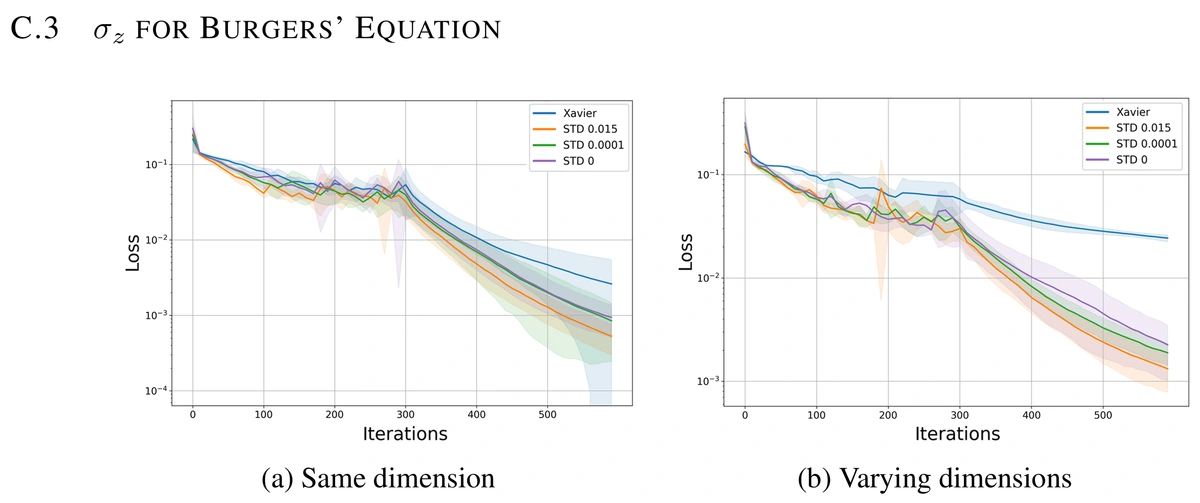
PINN training loss for the Burgers equation under different initialization settings.
Lab research introduction, 2025View full-size figureThe plots compare PINN training-loss trajectories for a Burgers-equation example under different initialization settings.
02 / RESEARCH DIRECTION
AI for Mathematics
How can learning methods respect equations and physical constraints?
Physics-informed machine learning and deep numerical methods that combine neural networks with differential equations and numerical analysis.
- Focus
- Differential equations
- inverse problems
- learning with physical constraints and observations
- Methods
- Physics-informed learning
- Deep numerical methods
- Inverse problems
RESEARCH EXAMPLE / 2025
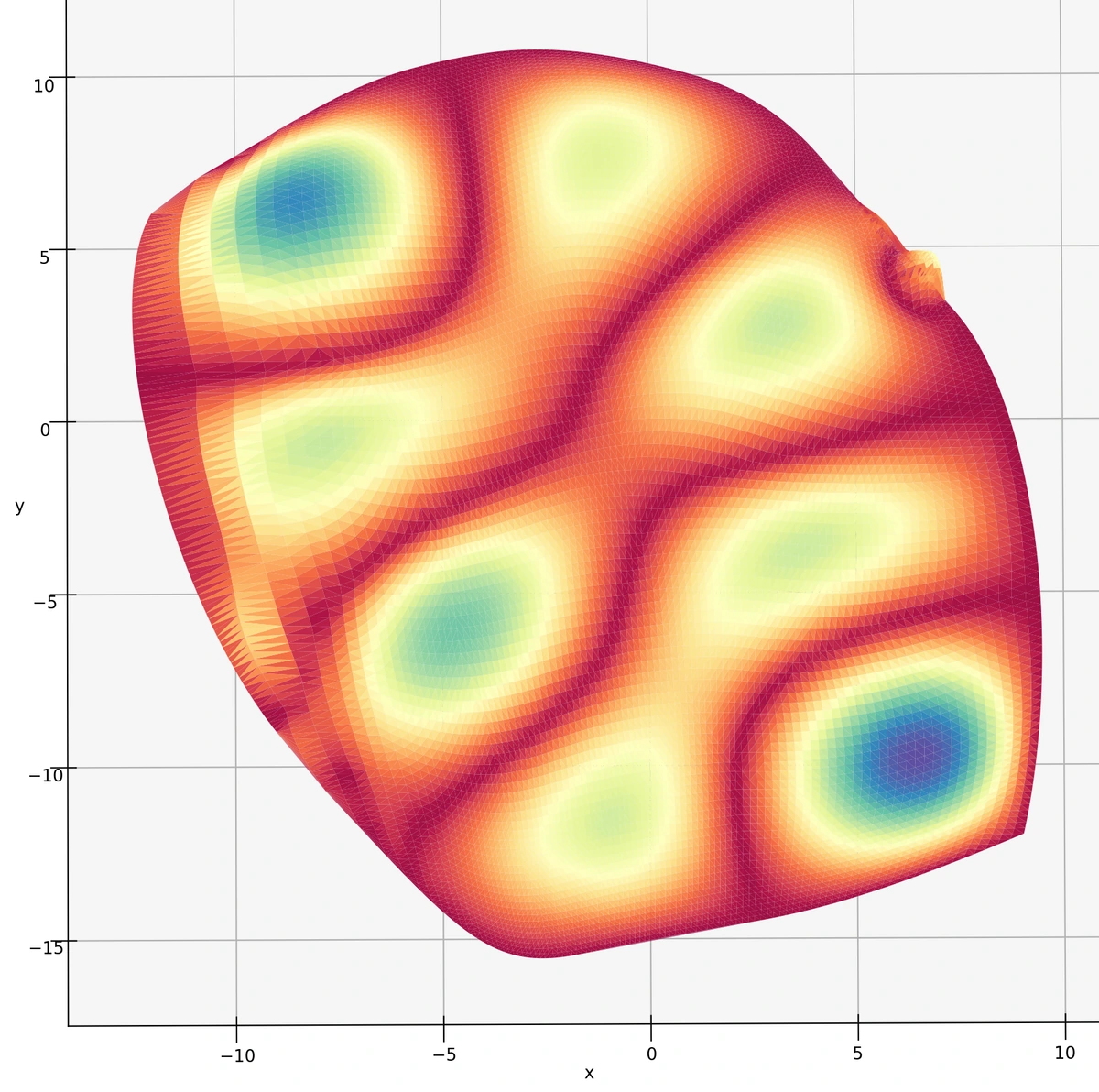
Helmholtz approximation using isogeometric collocation combined with a neural network.
Lab research introduction, 2025View full-size figureThe surface shows a Helmholtz approximation on curved geometry, combining isogeometric collocation with a neural network.
03 / RESEARCH DIRECTION
Simulation, Analysis & Modeling
How can we represent geometry, memory and physical dynamics?
Mathematical models and numerical methods for physical systems, including fluid flow, heat transfer, phase-field models, and fractional dynamics.
- Focus
- Partial differential equations
- fluid flow and heat transfer
- geometric singularities
- fractional dynamical systems and optimization
- Methods
- Numerical analysis
- Mathematical modeling
- Fractional dynamics & optimization
RESEARCH EXAMPLE / 2025
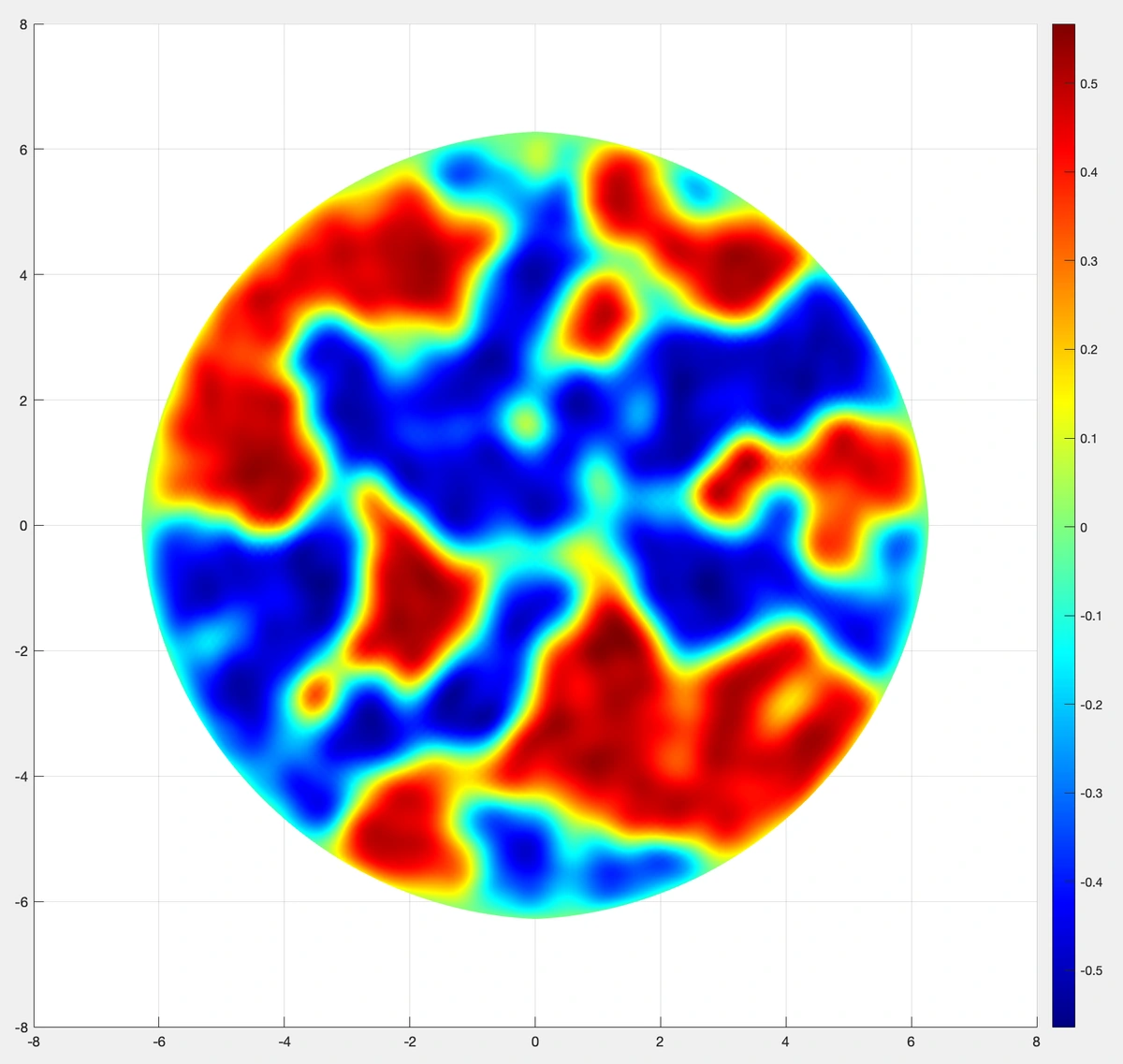
Phase-field modeling on a circular domain.
Lab research introduction, 2025View full-size figureThe spatial pattern is a phase-field example on a circular domain. The source does not specify a time or fractional order.
Numerical research foundations
Geometry & singularities
Isogeometric, generalized finite element, and mapping methods for differential equations in domains with cracks, corners, and boundary layers.
Related publications
Mapping techniques for isogeometric analysis of elliptic boundary value problems containing singularities
Computer Methods in Applied Mechanics and Engineering · 254 · 334–352
DOI: 10.1016/j.cma.2012.09.009Fractional differential equations
Efficient methods for fractional initial and boundary value problems, nonlinear time-fractional equations, and fractional dynamical systems.
Related publications
An efficient numerical approach for solving two-point fractional order nonlinear boundary value problems with Robin boundary conditions
Advances in Difference Equations · 2021 · Article 193
DOI: 10.1186/s13662-021-03355-3A fast and high-order numerical method for nonlinear fractional-order differential equations with non-singular kernel
Applied Numerical Mathematics · 163 · 57–76
DOI: 10.1016/j.apnum.2021.01.013Shifted Jacobi spectral-Galerkin method for solving fractional order initial value problems
Journal of Computational and Applied Mathematics · 380 · Article 112988
DOI: 10.1016/j.cam.2020.112988New explicit and accelerated techniques for solving fractional order differential equations
Applied Mathematics and Computation · 379 · Article 125228
DOI: 10.1016/j.amc.2020.125228Computational mechanics
Numerical approximation for elasticity and plate models, including problems with cracks, singularities, and fourth-order partial differential equations.
Related publications
Implicitly enriched Galerkin methods for numerical solutions of fourth-order partial differential equations containing singularities
Numerical Methods for Partial Differential Equations · 34(6) · 2079–2112
DOI: 10.1002/num.22277RESEARCH ROLE
A common foundation.
A connected research hub.
Our mathematical and computational methods provide a shared foundation for research across these fields.
Faculty research overviewMathematics connects the fields.
- Mathematical analysis
- Learning methods
- Simulation & modeling
- AI
- Hydrogen
- Batteries
- Power grids
- Nuclear research